

Is Moissanite Fake?
The question is asked frequently — and often with hesitation:
Is moissanite fake?
The answer is no.
But to understand why this misconception exists, it’s important to define what “fake” actually means in the context of fine jewelry.
What Does “Fake” Mean in Jewelry?
In jewelry, a stone is typically considered “fake” if it:
-
Is made of inexpensive materials
-
Has no defined crystal structure
-
Imitates appearance without matching physical properties
-
Degrades or loses brilliance over time
Examples include glass or low-grade cubic zirconia — materials designed to resemble gemstones visually, but without comparable durability or performance.
Moissanite does not fit this definition.
What Moissanite Actually Is
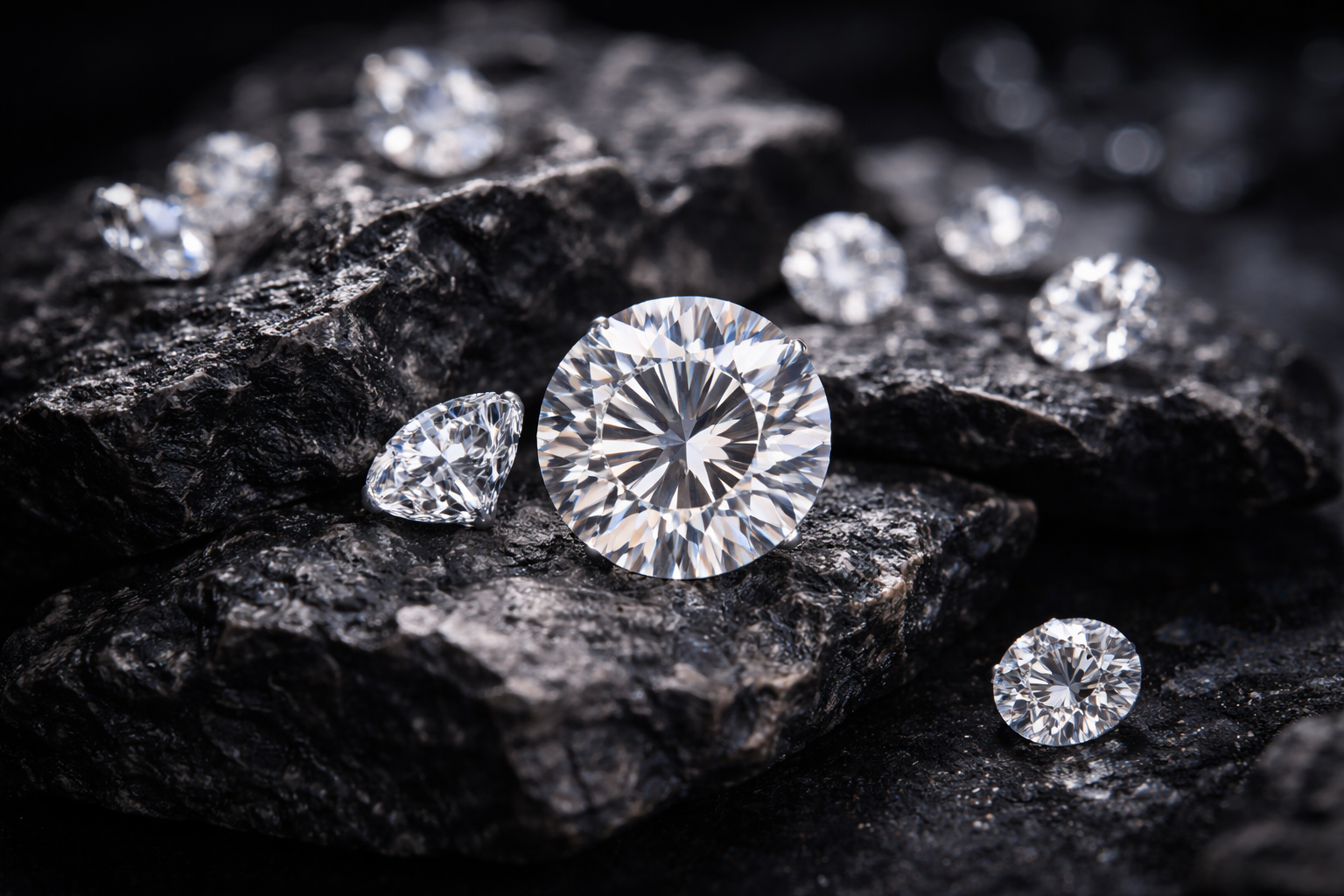
Moissanite is a real gemstone with a defined chemical composition: silicon carbide. It has its own crystal structure, optical properties, and physical performance characteristics.
Originally discovered in nature, modern moissanite is now precision-created to ensure consistency in clarity, color, and structure. This process does not make it “fake” — it makes it controlled.
Just as lab-grown diamonds are real diamonds, moissanite is a real gemstone created through advanced engineering.
Physical Properties That Matter
Moissanite’s measurable properties place it among the highest-performing gemstones used in fine jewelry:
-
Hardness: 9.25 on the Mohs scale
-
Exceptional thermal conductivity
-
High refractive index, resulting in superior brilliance and fire
-
Permanent clarity and stability
These are not characteristics of imitation stones.
In fact, moissanite is one of the very few gemstones that can pass a standard diamond tester due to its thermal conductivity — something fake stones cannot do.
Why the Confusion Exists
The misconception largely comes from outdated assumptions:
-
Anything that isn’t diamond is often labeled “fake”
-
Older simulants blurred the line between imitation and engineering
-
Marketing history positioned diamond as the only “real” option
Modern gemstones challenge those narratives. Moissanite is not trying to be a diamond — it simply performs at a comparable, and in some cases superior, level.
Moissanite vs Cubic Zirconia
This comparison is often misunderstood.
-
Cubic zirconia is a low-cost simulant with poor long-term durability
-
Moissanite is a high-performance gemstone designed for longevity
Zirconia can scratch, cloud, and lose brilliance over time. Moissanite does not.
Lumping these two together is inaccurate and misleading.
Transparency Matters
What defines integrity in jewelry is not whether a stone is natural or created — but whether it is clearly disclosed.
Reputable brands identify moissanite as moissanite, provide certification, and never misrepresent it as diamond.
At JUVÉ, every stone is:
-
Clearly disclosed as moissanite
-
Diamond tester approved
-
Accompanied by official GRA certification
A Modern Definition of “Real”
Moissanite is not fake — it is engineered for performance. It represents a modern approach to fine jewelry, where value is defined by durability, brilliance, and execution rather than geological rarity alone.
As consumer understanding evolves, so does the definition of luxury.
The Takeaway
Moissanite is a real gemstone with real properties, real durability, and real value.
Calling it “fake” misunderstands both the material and the science behind it. The more accurate question is not whether moissanite is real — but whether traditional assumptions still apply.




Leave a comment
This site is protected by hCaptcha and the hCaptcha Privacy Policy and Terms of Service apply.